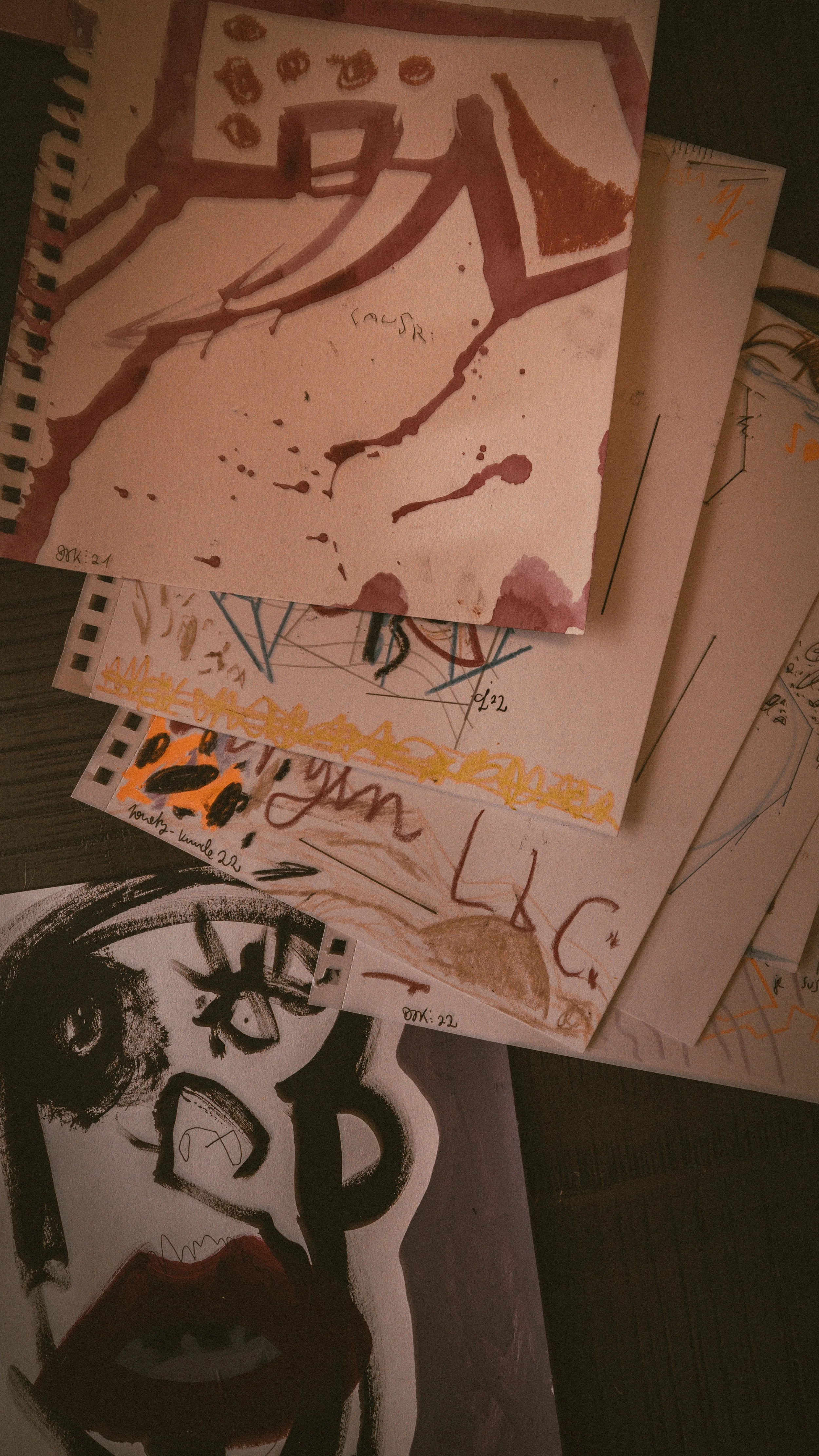
Five Modalities & Seven Ciphers
The practice of Dori Jonetz-Knude unfolds through five interconnected modalities—drawing, painting, sculpture, installation, and performance—which together comprise a single investigative framework. Rather than functioning as separate disciplines, each medium addresses a distinct aspect of a sustained inquiry into genealogy, memory, language, and inherited systems of thought.
Drawing occupies a foundational position within the oeuvre. It is the site at which forms first emerge and where relationships between figure, inscription, gesture, and historical reference are tested with the greatest degree of freedom. The drawings are autonomous works whose economy of means permits a density of conceptual association that informs every subsequent modality.
Painting extends these investigations into material space. Across the cosmology, the painted surface evolves from relatively restrained handling toward increasingly physical accumulations of pigment that transform the canvas into a shallow relief. In later works, paint no longer functions solely as color or mark but assumes the status of object, projecting into the viewer’s space and complicating the distinction between image and sculpture. This gradual expansion of the painted surface parallels the broader movement of the cosmology from representation toward embodiment.
Sculpture carries this transition further. Objects are not conceived as translations of painted motifs but as parallel manifestations of the same genealogical questions. Materials, found forms, and constructed elements are assembled as physical analogues to inherited structures that recur throughout the wider body of work.
Installation situates individual works within architectural space, allowing relationships between cycles to become visible through proximity, sequence, and scale. Rather than presenting discrete objects, installations emphasize the cosmology as an interconnected field whose meanings emerge through accumulation and comparison.
Performance returns these inherited structures to the body itself. Here genealogy is neither represented nor symbolized but enacted, locating the painter as both participant and witness within the systems under examination.
Across these five modalities, a recurring vocabulary of seven ciphers establishes continuity between otherwise disparate works. These forms do not operate as fixed symbols but as mutable visual constants whose meanings shift according to context while maintaining structural coherence across the cosmology.
The recurring Son/Sun functions as an orienting presence, frequently occupying an elevated position within the composition and introducing questions of revelation, ancestry, illumination, and theological inheritance. Its repeated appearance establishes a consistent point of orientation rather than a stable iconographic meaning.
INRI similarly exceeds its biblical origin. Rather than serving as devotional reference, it recurs as an inscription through which questions of authority, judgment, sacrifice, and historical memory intersect. Throughout the oeuvre, language is treated as material rather than explanatory, and INRI participates in this broader understanding of inscription as image.
Gedankengut—literally “thought material”—identifies inherited systems of belief that precede individual experience. Whether religious, political, familial, or cultural, these accumulated structures function less as subjects than as conditions under which the work itself becomes possible.
The acne dots, originating in autobiographical experience, undergo one of the most significant transformations within the practice. Initially tied to the body, they gradually detach from biography and recur as dispersed pictorial units whose function shifts between wound, constellation, cellular formation, atmospheric field, and compositional rhythm. Their migration from epidermis to pictorial structure exemplifies the movement through which lived experience becomes formal language.
The Box appears as a recurring condition of containment. It suggests institutional, psychological, and architectural frameworks while simultaneously functioning as a compositional device through which figures, inscriptions, and historical references are organized.
The repeated appearance of the number 33 introduces a temporal and theological register whose significance remains deliberately open. Rather than resolving into a single symbolic meaning, it operates as a recurring interval within the larger grammar of the cosmology.
Finally, the Schnabelschuh—the medieval pointed shoe—compresses historical duration into a single recurring form. Its appearance establishes an unexpected continuity between contemporary figures and longer European visual traditions, emphasizing genealogy as an embodied rather than abstract condition.
Taken together, the five modalities and seven ciphers constitute the internal architecture of Jonetz-Knude’s practice. Rather than providing a symbolic key through which individual works may be decoded, they establish a recurring visual grammar whose significance becomes legible only through sustained attention to the oeuvre as a whole. Across approximately 2,400 works organized within ten interrelated cycles, repetition does not produce redundancy but variation, allowing inherited structures to register differently from one medium, one cycle, and one work to the next. It is through these continual shifts—rather than through singular images—that the practice advances its central proposition: that genealogy may operate not only as subject matter but as a compositional principle governing the formation of the work itself.
Rather than treating genealogy as a single lineage, the paintings repeatedly operate at the intersection of multiple inherited systems.
For example:
German historical inheritance
Black American inheritance
Christian inheritance
military inheritance
regional linguistic inheritance
familial inheritance
sexual inheritance
These are not subjects.
They function as pressures acting upon composition.
Different cycles activate different constellations.